Let’s be honest — the grant world is competitive. Thousands of Native American entrepreneurs are searching for the same funding windows, filling out the same forms, and waiting months (sometimes over a year) for an answer. And yet, many strong businesses are passed over — not because they lack potential, but because they weren’t “grant-ready” when the opportunity arrived.
This guide is your roadmap to both finding the right native american business startup grants and showing up prepared when those application windows open.
Top Federal Grant Opportunities for 2026
The federal government offers several targeted programs designed specifically to support Native American entrepreneurs. Here are the three most significant ones to have on your radar.
1. SBA Native American Trade Expansion Program (NATEP)
If your business is ready to grow into export markets, NATEP is one of the most powerful tools available. Administered by the U.S. Small Business Administration, this program provides funding and technical assistance to help Native-owned businesses compete in the global marketplace. It’s especially well-suited for businesses in agriculture, manufacturing, crafts, or professional services with cross-border potential.
- Ideal for: Established businesses exploring export markets
- Key benefit: Access to trade counseling, matchmaking, and export-readiness training
- Where to apply: sba.gov — search “NATEP“
2. BIA Native American Business Development Institute (NABDI) Grants
Run by the Bureau of Indian Affairs, NABDI grants support economic feasibility studies. In practical terms, this means if you have a business idea and need to assess whether it’s viable — before you invest significant resources — NABDI can fund that research.
- Ideal for: Early-stage entrepreneurs testing a new concept
- Key benefit: Pays for feasibility studies, market research, and planning
- Eligibility: Federally recognized tribes and tribal members
3. Indian Business Incubators Program (IBIP)
The IBIP is one of the most startup-friendly programs available. Funded through the Administration for Native Americans (ANA), it supports incubators that directly serve Native entrepreneurs at the earliest stages — providing the seed resources, mentorship, and infrastructure needed to grow a new enterprise from the ground up. Even if you’re pre-revenue, this program was built for you.
- Ideal for: New startups, pre-revenue businesses
- Key benefit: Access to mentorship, workspace, tools, and early-stage capital
- Where to find programs: Check your local tribal economic development office
Private & Non-Profit Funding Sources
Federal grants aren’t the only path. Several mission-driven organizations provide funding specifically for Native entrepreneurs outside the government pipeline.
First Nations Development Institute
First Nations offers grants and technical assistance to Native-led organizations and businesses. Their focus is on economic sovereignty and sustainable development in Native communities. They periodically open competitive grant cycles — visit firstnations.org to track current opportunities.
Merchant Maverick Opportunity Grants
Merchant Maverick, a small business resource platform, offers grants targeted at underserved entrepreneurs, including Native-owned businesses. These are smaller in size but require less administrative paperwork than federal programs — making them a good “quick win” to pursue while waiting for larger cycles.
| 💡 Pro Tip:Combine your strategy. Apply for smaller private grants first to build your application track record, then use that experience when applying to federal programs. |
The ‘Gap’ — What to Do While You Wait
Here’s a truth most grant guides won’t tell you: after you apply, you wait. Federal grant cycles typically take anywhere from 6 to 18 months from application to decision. That’s not a flaw — it’s just the reality of competitive public funding.
The question is: what do you do with that time?
The entrepreneurs who receive funding are rarely just the ones with the best idea. They’re the ones who show up with a clear mission, a defined community role, and a business identity that grantors can immediately understand and champion.
This is the “gap” most applicants miss. They focus on the application form but haven’t yet done the deeper work of defining their business’s place in the circle.
| 🌀 Introducing: Finding Your Role in the Circle (Free Course) Our free course was built specifically for this moment — the pre-grant phase. It walks you through clarifying your business mission, identifying your community role, and articulating your “why” in a way that resonates with both grantors and customers. Most grants require a solid business identity. This course helps you build exactly that — so when the window opens, you’re not starting from scratch.👉 Enroll free at Finding Your Role In Circle |
Use the waiting period to:
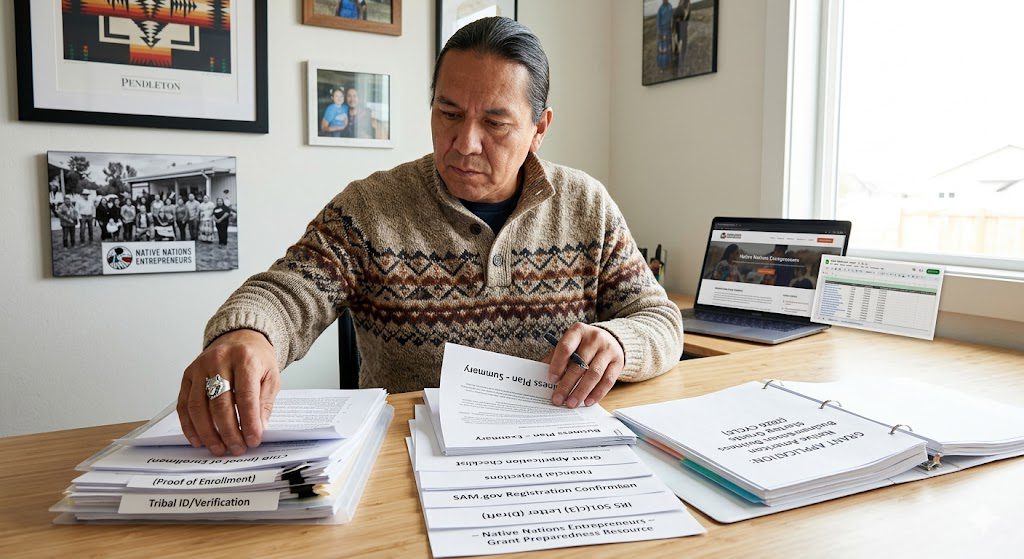
- Complete your SAM.gov registration (required for most federal grants)
- Gather your CDIB (Certificate of Degree of Indian Blood) documentation
- Write a one-page business mission statement
- Define how your business serves your tribal community
- Begin building relationships with your local tribal economic development office
What Are the Eligibility Requirements for Native American Grants?
While requirements vary by program, most native american business startup grants share a common set of criteria:
- At least 51% Native American ownership of the business
- Proof of tribal enrollment — typically a CDIB card or tribal enrollment letter
- Registration as a small business under SBA size standards
- SAM.gov registration (for all federal grants — register at sam.gov)
- A current business plan or feasibility plan
Some programs — like NABDI — are restricted to federally recognized tribe members and tribal enterprises. Others, like IBIP, may work through tribal incubators. Always verify current eligibility on the official program pages, as requirements can shift between funding cycles.
Frequently Asked Questions
These are the questions most Native American entrepreneurs are searching for. We’ve answered them directly.
| Q: How do I qualify for Native American business startup grants?A: Generally, you must be a registered small business with at least 51% Native American ownership. Most federal grants require proof of tribal enrollment (your CDIB card) and an active SAM.gov registration. A solid business plan is also typically required. Start by pulling those documents together — it will speed up every future application. |
| Q: Are there grants specifically for new startups with no revenue?A: Yes. The Indian Business Incubators Program (IBIP) is designed specifically to provide the seed resources, tools, and mentorship needed to grow a new enterprise from the ground up. Some tribal economic development departments also offer micro-grants for pre-revenue businesses. Don’t count yourself out just because you’re early-stage. |
| Q: What is the biggest mistake people make when applying for grants?A: Applying without a clear ‘why’ or community role. Grantors want to see how your business serves a larger purpose — not just how it generates revenue for you personally. Before you submit a single application, take time to define your mission. Our free course, Finding Your Role in the Circle, was built to help you do exactly that. |
| Q: How long does it take to get grant funding?A: Expect anywhere from 6 to 18 months from application to decision for federal programs. Private grants can move faster — sometimes 2 to 4 months. This is exactly why the ‘pre-grant phase’ matters: the time you spend building your business identity now is what makes your application land when the window opens. |
| Q: Are there grants for specific tribes or regions?A: Absolutely. Your first stop should be your local tribal economic development department. Many tribes administer their own business development funds that aren’t listed on federal websites. These tribal-level grants are often less competitive and more aligned with your specific community. Ask your tribe’s economic development director what’s currently available. |
| Q: How do I apply for Native American startup grants?A: Start with SAM.gov registration — this is required for all federal grants and takes 1-2 weeks to process. Then gather your CDIB documentation and prepare a one-page business plan. From there, research the specific programs above (NATEP, NABDI, IBIP) and track their application cycles. Most open once or twice per year. |
Conclusion: Funding Is a Tool — Your Role Is the Engine
Grants are powerful. But they’re a tool, not a foundation.
The businesses that build real, lasting impact in Native communities aren’t the ones who got lucky with a grant cycle. They’re the ones who knew exactly who they were, what they were building, and why it mattered — before the money arrived.
That’s your mission right now. Understand your role in the circle. Build the foundation. Then let the funding amplify what you’ve already created.
| 🎯 Your Next Step: Before you fill out another grant application, spend 30 minutes in our free course: Finding Your Role in the Circle. It’s the pre-work that makes everything else stronger — your application, your pitch, your purpose.👉 Start the free course at Find your role | 👉 Get your Free SEO Audit |